
By Stephanie Mellinger HealthDay Reporter
THURSDAY, Oct. 29, 2026 (HealthDay News) — Whether you realize it or not, you’re probably already familiar with calisthenics.
Put simply, calisthenics is just bodyweight exercises. Calisthenics is great for beginners because it builds full-body strength and requires no equipment. You can also easily modify exercises for different levels of difficulty.
Why Calisthenics Works
People have been doing bodyweight training since ancient Greece, and for good reason. It does more than build muscle.
Experts at Harvard Health Publishing say calisthenics can also boost your endurance, flexibility and coordination. Research also links it to better aerobic fitness and a stronger core.
You don’t need a big time commitment to see results. Harvard points to one study in which eight basic lower-body exercises (think squats, knee lifts and heel raises) raised muscle strength and power by 15% over 10 months.
It’s also free, and you can do calisthenics whenever and wherever it suits you. As you get stronger, you can make the moves harder by adding reps, small pulses or holds.
If you want to try calisthenics, here are my top five favorite calisthenics exercises. Even with no equipment, these moves still give you a great workout.
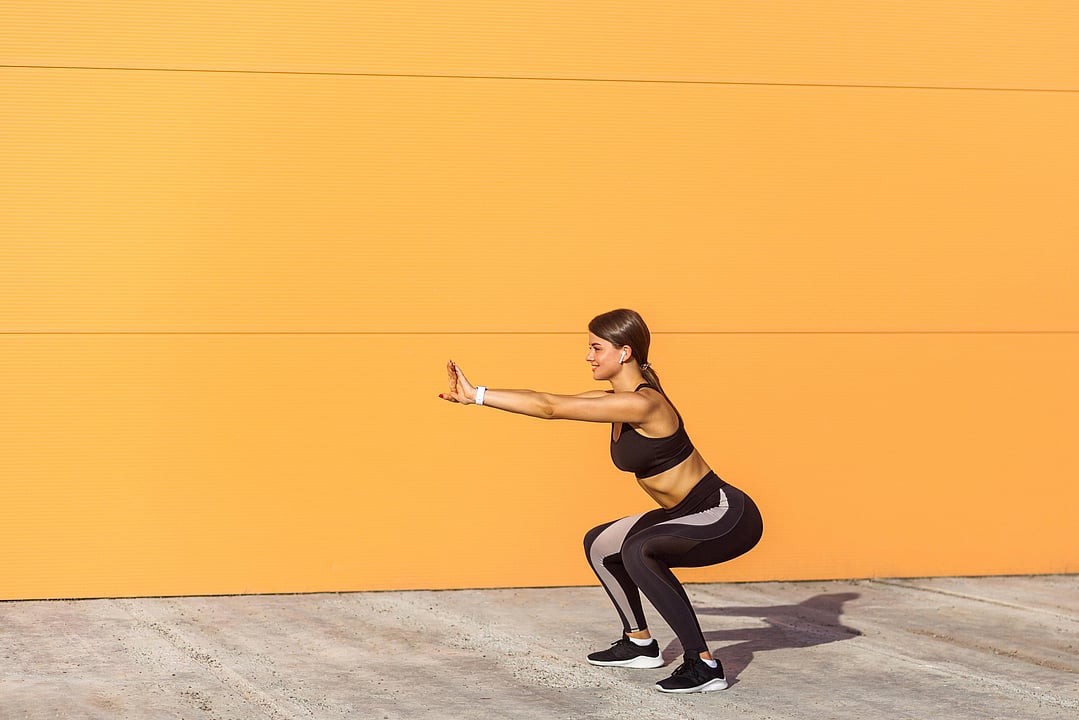
1. Squat
I love this move because it trains a movement pattern we use daily: sitting and standing. It works your core and most of your lower body muscles.
How to do a squat:
Stand with your feet a little wider than hip-distance apart.
Lower your hips as if you’re about to sit in a chair. Go as low as you can, or until your thighs are parallel with the ground.
Push your feet down, and squeeze your glutes and abs as you stand back up.
Do three sets of 10 reps.
2. Incline Push-up
Push-ups are great because they combine the benefits of planks while also improving upper body strength.
Adding an incline to a traditional push-up can take some pressure off your upper body, so you can build up strength to do a push-up with your hands on the ground.
You’ll feel this move mainly in your chest, arms and abs.
How to do an incline push-up:
Place your hands on an elevated surface, such as a bench, a little wider than your shoulders.
Pull your belly button toward your spine to engage your core — don’t let your lower back arch.
Bend your arms and lower your chest toward the bench as low as you can. Your body should look like an arrow, with your elbows about 45 degrees away from your sides.
Do three sets of 10 reps.
3. Glute Bridge
The glutes are our biggest muscle group. Keeping them strong can also help stabilize our hips and pelvis and potentially reduce or prevent lower back pain. This move also strengthens your core.
How to do a glute bridge:
Lie on your back with your knees bent and feet flat on the floor. Keep your arms straight at your sides, and let your heels almost touch your fingertips.
Pull your belly button toward your spine to align your pelvis and engage your core.
Push your heels into the floor as you slowly lift your hips off the ground.
Hold for one second, then slowly lower until your back is on the ground.
Do three sets of 10 reps.
4. Superman
Most of us live life in a forward-rounded posture: hunched over our computers and rounded over our phones.
The Superman exercise works the upper back, shoulders, glutes and abs to improve posture and potentially reduce or prevent neck and lower back pain.
How to do a superman:
Lie on your stomach with your arms over your head forming a “Y” shape with your upper body (for an easier modification, create a “W” shape with your upper body instead by bending your elbows in a bit).
Lift your arms and thighs off the ground and hover them a few inches above the ground. This doesn’t have to be a huge movement, so don’t worry if you can’t lift them very high.
Hold for three seconds.
Slowly lower back to the ground and repeat.
Do three sets of 10 reps.
5. Lateral Lunge
I love exercises that move us laterally (to the side) because most of us live life in a forward plane of motion, such as walking.
This calisthenics exercise strengthens muscles we may not normally use. You’ll feel this move in your glutes, quads and inner thighs.
How to do a lateral lunge:
Take a large step toward your right and bend only your right knee as you lower yourself toward the ground. Your left leg should remain straight.
Like a squat, lower your hips as if you’re about to sit in a chair. Go as low as you can, or until your right thigh is parallel with the ground.
Push off of your entire right foot (not just the ball of your foot), and bring your feet back together.
Do 10 on your right side, and then repeat on your left side.
Do three sets of 10 reps on each side.
Tips For Getting Started
A few habits will help you get more out of these moves and lower your risk of injury, Harvard experts say.
Warm up for five to 10 minutes before you start. Add reps and sets slowly as you get stronger rather than doing too much too soon.
Keep each move slow and controlled, and keep breathing, since holding your breath during strength exercises can drive up your blood pressure.
Your muscles also need time to recover. The American College of Sports Medicine suggests no more than two or three full strength workouts a week, ideally with a day off between them.
If you have a health condition such as heart disease, diabetes, arthritis or osteoporosis, talk with your doctor before starting a new exercise routine.
More information
The Cleveland Clinic has more information about getting started with calisthenics.
SOURCES: Stephanie Mellinger, certified personal trainer; Harvard Health Publishing, Oct. 3, 2024
Back

The news stories provided in Health News and our Health-E News Newsletter are a service of the nationally syndicated HealthDay® news and information company. Stories refer to national trends and breaking health news, and are not necessarily indicative of or always supported by our facility and providers. This information is provided for informational and educational purposes only, and is not intended to be a substitute for medical advice, diagnosis, or treatment.



